

PaperInsight
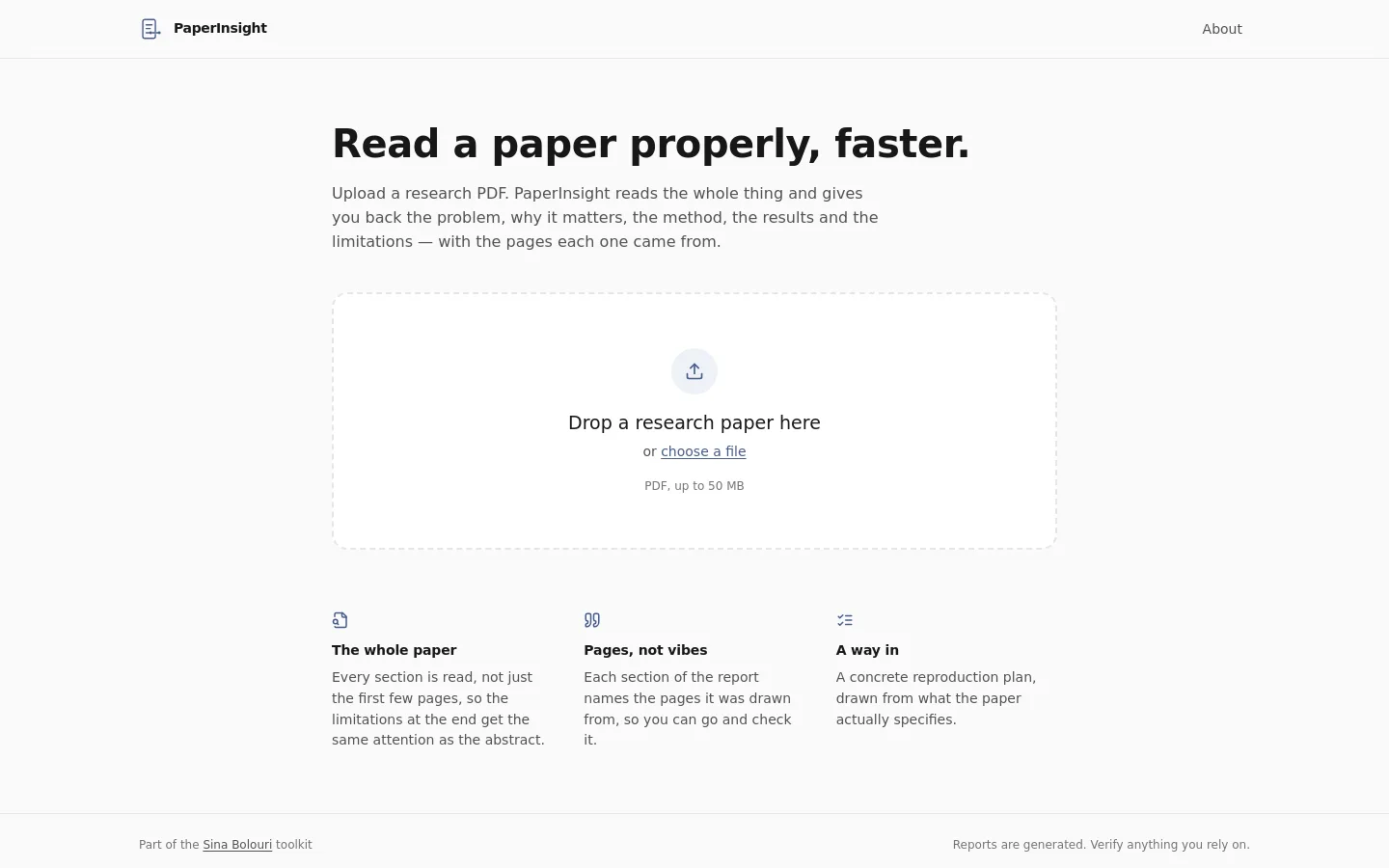
PaperInsight turns an uploaded research PDF into a structured report:
- the problem
- why it matters
- the method
- the results
- the limitations
- a reproduction plan
Each field records the pages it came from. It is live at paperinsight.inquivent.com as one of the three Inquivent products, alongside Axiomizer (first-principles explanations) and Dataxiom (reproducible studies).
It is deliberately not a chat window over a PDF. The output is a fixed structure you can read top to bottom, return to at the same link and check against the source.
Problem
Reading a paper well takes hours, and the parts that matter most for judging or reproducing it (limitations, the exact method, what the results actually show) are often buried late in the document. Generic summarisers tend to read only the first few pages and can return confident text with nothing tying it back to the source.
Solution
A three-service pipeline:
- Next.js frontend. Upload, progress and the report reader.
- Spring Boot API. Validates the upload, stores the file, creates a job and queues it.
- Python Celery worker. Extracts the text with its page numbers, splits it into sections and page-anchored chunks, then runs hierarchical LLM extraction. It writes a digest per section, then synthesises a paper-level report from the digests.
Every report is validated against a JSON Schema shared by all three services. If validation fails, one repair pass runs. If that also fails, the job fails with a readable reason. A malformed report is never saved as a success.
The LLM sits behind a provider interface. Production uses Google's Gemini 3.8 Flash; local development can use Ollama with Llama 3.1 8B; a heuristic mode runs without any model and is used in CI's end-to-end test. Every LLM call is logged with tokens, latency and an estimated cost. A monthly budget guard stops new uploads before the estimate exceeds it.
User Experience
- Upload a PDF (up to 50 MB) on the home page.
- Watch the job move through its stages: queued, text extraction, chunking, field extraction, validation, saving.
- Read the finished report at
/papers/<jobId>, with its sections and a method diagram. The link can be revisited. - When the worker finds the paper's DOI or arXiv ID, the report offers "Explain this paper" (Axiomizer) and "See the study" (Dataxiom), but only when those products confirm they cover the paper.
There are no accounts. Anyone with a report link can read that report.
Current Status
Deployed.
- The first production report completed on 2026-11-08, in about one minute.
- On 2026-11-09 the frontend and the API health check answered 200, and
paperinsight.sinabolouri.comreturned a 301 topaperinsight.inquivent.com.
Not built, by design for the MVP: authentication, upload rate limiting, an evidence viewer, figure and table extraction, RAG, embeddings, paper chat, cross-paper comparison and billing. See STATUS.md.
Tech Stack
- Frontend: Next.js 16 (App Router), React 19, TypeScript and Tailwind CSS, with
@inquivent/brandand@inquivent/research-idsfrom npm. - API: Java 21 and Spring Boot 4.0 with JDBC and Flyway.
- Worker: Python 3.11 with Celery, pypdf and jsonschema.
- State: PostgreSQL on Neon, Redis on Upstash (TLS) and Cloudflare R2 for the uploaded PDFs.
- AI: Gemini 3.8 Flash in production, Ollama locally.
- Hosting: Docker on Railway, behind Cloudflare.